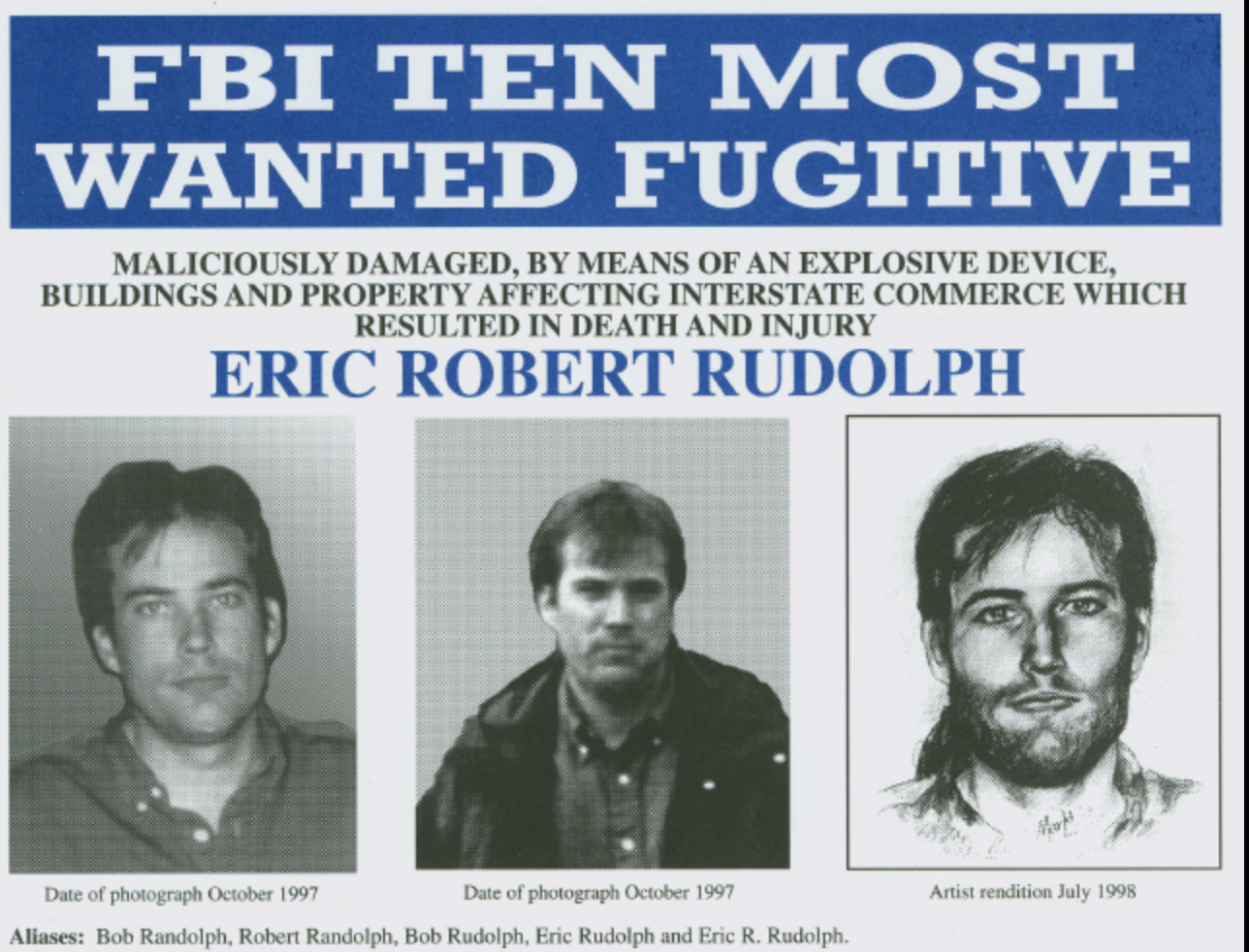
Today, September 19th, is the birthday of Eric Robert Rudolph, a native of Florida, who now spends 23 hours a day in a 7-by-12-foot cell at the ADX Florance, Supermax Prison in Colorado.
Rudolph is serving four consecutive life sentences. The residents of Nantahala will never forget the disruption and fear that he brought to our community.
Eric Rudolph's association with the Nantahala area is a complex and unsettling chapter in Nantahala's recent history. His presence in our mountains is tied both to his early upbringing and to the years he spent hiding in the region during one of the most extensive manhunts in U.S. history. As a convicted domestic terrorist responsible for multiple bombings that killed and injured innocent people, Rudolph's legacy is one of harm and violence, and his connection to Nantahala is always remembered through that lens.
Eric Rudolph's Early Connection to Nantahala
Rudolph first came to the area in 1981, when he was 15. After the death of his father, his mother had moved the family from Florida to a six-acre homestead in the mountains near here. Their life was remote and self-sufficient: the family lived off the grid, raised animals, and grew their own food. This period shaped Rudolph's familiarity with the rugged terrain and his comfort with wilderness survival.
During these formative years, Rudolph spent significant time outdoors and developed the skills that would later allow him to evade law enforcement. He also became acquainted with a few individuals who held radical anti-government views. For a time, his family lived in the Missouri Ozarks, where he became closely associated with the Christian-Identity movement. These influences, combined with personal upheaval, contributed to the extremist ideology Rudolph later embraced.
The Eric Rudolph Manhunt in Nantahala National Forest
Rudolph's association with Nantahala deepened and turned dark, after he became the prime suspect in a series of bombings between 1996 and 1998, including the attack at Centennial Olympic Park in Atlanta and the bombing of a Birmingham abortion clinic. When authorities closed in, Rudolph fled into the Nantahala National Forest on January 30, 1998. His knowledge of the land—steep ridges, dense forests, and remote hollows—gave him an advantage that frustrated search teams for years.
The FBI flooded the area with agents and assets. At its peak the task force numbered over 200 federal agents, supplemented by Army Special Forces trackers, state and local law enforcement and dog teams. A staging area went up on U.S. 74 between Murphy and Andrews. Helicopters swept the ridges. A million-dollar reward was posted. Local residents locked their doors, loaded their guns and watched.
To a few, despite his horrific crimes, Rudolph became a sort of folk hero; a lone, local individual eluding the feds and all of their high-tech equipment. Some agreed with his opposition to gay bars and abortion clinics. To the vast majority however, the death and violence he brought was completely unacceptable and they wanted him captured and put away as quickly as possible.
They supported the manhunt, cooperated with law enforcement and volunteered both theories and information. The total cost of the manhunt eventually reached $24 million.
Throughout the manhunt, there were occasional sightings and encounters in Nantahala that underscored his continued presence in the area. In July 1998, a local health-food store owner, who then lived on Long Branch Road not far from our cabins, reported that Rudolph came to his home seeking food and supplies.
Although the resident initially agreed to help, he later changed his mind and notified authorities. The resident later moved, though the house remains. This incident reinforced investigators' belief that Rudolph remained in the region, relying on both the wilderness and sporadic contact with locals to survive.
Eric Rudolph's Capture in Murphy and His Lasting Impact on Nantahala
The FBI, convinced by Rudolph's familiarity with the terrain and lack of credible sightings elsewhere, maintained its focus on Western North Carolina for five years. Agents went door to door throughout the forest.
Their persistence finally paid off in 2003 when Rudolph was captured by rookie police officer Jeff Postell in nearby Murphy, ending five years of tension and uncertainty. Postell, then 21 had been on the Murphy Police Force just nine months. He became a local hero and is now a sergeant at the Boston College Police Department.
Today, Rudolph's connection to Nantahala is remembered not as a point of local identity but as the time our remote mountain landscapes became entangled in national events. Rudolph's years in the area left a lasting imprint on the community—one marked by vigilance, resilience, and the sobering reality that a violent extremist had spent years hiding in our mountains.